Way back when I was just a little bitty boy living in a box under the stairs in the corner of the basement of the house half a block down the street from Jerry's Bait shop...
You know the place...
Actually, I never lived near a Jerry's Bait shop, but way back when I was a boy (I don't think anyone has EVER described me as "little bitty"), at the ripe age of 10, I was introduced to Weird Al, specifically the "Weird Al in 3D" album. I must have listened to that absolutely-100%-totally-legal cassette copy 27,000 times. I knew all the lyrics to all the songs. And I still do, in most cases.
Over the years I have purchased just about every album he has released. My friends and I spent countless hours learning to play his songs, singing them on Boy Scout adventures, and annoying the !@#$ out of our parents and siblings with fun phrases like, "Today we are teaching Poodles how to fly. Nope, not today!" And don't get me started about the multifaceted debates/arguments/fights we had regarding Dare to be Stupid and Albuquerque.
OK, I admit, I really like Weird Al.
And then, last week, I discovered I LOVED Weird Al. No, not that kind of love...
Time to 'splain Lucy...
I have a son with Asperger Syndrome. Life with him is never a dull moment. He is 10 years old now and, through the wonderful magic that is ABA, OT, and PT, he is beginning to live a semi-normal life compared to his normally-abled peers. Even so, there are things that he really struggles with that most people take for granted.
The most recent struggle involves sarcasm. According to Wikipedia, which is never wrong, sarcasm is defined thusly-
Sarcasm is "a sharp, bitter, or cutting expression or remark; a bitter gibe or taunt." Sarcasm may employ ambivalence, although sarcasm is not necessarily ironic." The distinctive quality of sarcasm is present in the spoken word and manifested chiefly by vocal inflections". The sarcastic content of a statement will be dependent upon the context in which it appears.
Most people with Aspergers really struggle with this. My son simply does not recognize the facial expressions, vocal tones, or contextual clues that most people use when employing sarcasm.
My problem: my family lives and breathes sarcasm. It comes out of us as normally as any other language. Our conversations are not only saturated with sarcasm, they are dripping with it. But when speaking with my son I have to be very literal.
As an example of this frustration, you have to look no farther than Dr. Sheldon Cooper-
And then one day my son heard a new song by Weird Al and became our grammar nazi...
He can quote to you each and every one of the grammar rules and examples in the song. And he does so DAILY. Like this gem...
And then, after quoting the line above, he asked me, "Dad, what's sarcasm?"
Oh boy, here we go.
Me: "Sarcasm is when people say something but they aren't being literal about it. Kind of like when people use idioms."
Boy #3: "Then what is Irony? Is that like sarcasm?"
Me: "No, that's when something happens to someone and it's ironic. Like when a policeman gets pulled over for speeding."
OK, I wasn't helping. So we turned to his current, most-favorite form of literature, the comic book, in particular Garfield the cat and Calvin and Hobbes. It just so happens that two of his favorite comic book characters are masters of the art of sarcasm. And, because they are his favorite, we have plenty of source material from which to study.
Examples like this...
Does Calvin really want his Dad to sue him?
Does Garfield know that donuts aren't healthy for him? Does he care?
The contextual clues are all there-
Calvin looks bored (resting his head in his hand) and is looking away from him Dad in panel #3.
Garfield has a huge grin on his face which signifies that he likes what is about to happen.
My son didn't pick up on these right away. We had to read well over 100 pages of comics, with him analyzing each one, before he started to notice the clues. Then his ABA therapist got into the act and started working sarcasm into his sessions, both using and recognizing it.
In regular conversation he would quietly ask me, “That was sarcasm, wasn't it?” practicing incessantly until he had it mastered. I use the word “incessantly” because he really annoyed his brothers with it for a while. Now, two months later, he is starting to get it.
He (somewhat) understands what sarcasm is and is not (i.e. compared/contrasted with irony and metaphor).
He now uses sarcasm daily, typically in a humorous way, as opposed to an insulting or tedious way.
He tags every use of sarcasm with “that was sarcastic,” sung just like Weird Al.
I cannot express how big an accomplishment this was for him. My wife and I cried about this when we realized what had happened. I’m sure he will continue to struggle with sarcasm in the future but for now he at least understands the concept and can use it and recognize it.
I find myself going to the "Weird Al well" more and more these days. My oldest son was asking me about writing styles the other day (first person, third person, etc.) and wanted an example of "stream of consciousness" writing. I immediately pulled out "Trapped in the Drive-Thru" and "Albuquerque" by Weird Al. Now he gets it.
And now I find myself in the odd place of thanking Weird Al for "Word Crimes," profusely, I might add. The song that my kids sing at least once a day (also profusely).
I'm a nerd. I'm a geek. And I LOVE movies. This presents some interesting issues if you ever watch a movie with me: I CANNOT STAND the way technology is used and portrayed in movies, at least most of the time. Sometimes the writer/director/producer have no clue what they are doing with that technology.
And therein lies the rub. Their use of technology is so baaaaaaad that it completely ruins the movie-watching experience for me: it's just annoying even though I usually end up liking the film.
At other times the technology makes it oh, so beautiful.
I'm sure Neil deGrasse-Tyson feels the same way about how physics is portrayed in space. Oh, wait, he does, even when he actually likes the movie.
WARNING: Movie plots and key scenes will be discussed. No complaining later about spoilers!
Note: The movie Hackerz
will not be discussed or included in this list. In our house it is "the movie that shall not be named". It's right up there with Ishtar and Batman Forever. And The Red Baloon.
The Best
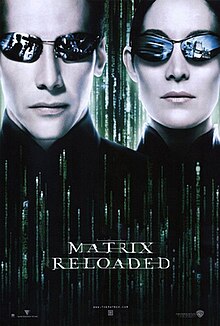
Matrix Reloaded (2003) - This one has to come first in my list because it marked an incredible "First" in movie history. In the movie there's this power plant where... oh, who cares? The movie wasn't that great. It served as a vehicle to get Neo into his epic battle with Elrond the Elf. And to teach us that French profanity sounds waaay cooler than English. But along the way Trinity does something incredible. She uses a real, unpatched SSH 1.0 buffer overrun vulnerability to hack into that power plant. She then changes the root password to Z1ON0101, and just like that, she is God on that system. When the movie came out in theaters you could use that hack to do some real damage. For the first time in history a fictional movie accurately portrayed a real hack.
Superman III (1983) - Before I go into just how cool the hack was in this movie, I do have to say that the rest of it is pure 1980s cheese. What was so cool about such a bad movie? Richard Pryor is a computer programmer who... OK, I laughed when I wrote that the first time. Richard Pryor... A nerd? Well, if he was he was one funny nerd. Anyway, he plays a software developer who writes a program that steals tenths and hundredths of cents and
funnels them into his own account. Brilliant. And parodied countless times
elsewhere.
WarGames (1983) - A kid, with a cobbled-together
computer, can connect into another computer a thousand miles away and use programs in a way someone didn't
think about with possibly disastrous consequences? In the early-80's, playing off the Cold War fears, this was big time stuff but it wasn't far outside the realm of possibility. Modems were around, although they were incredibly slow and there really was no public internet. Phone phreaking was a real thing (until people stopped using fax machines and AOL). In 1986 I saw CompuServe for the first time and was floored. What David Lightman did in WarGames helped inspire me to pursue a career in computers. No joke.
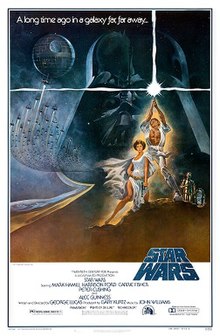
Star Wars Ep. IV (1977) - There is so much to say about this movie that I have to limit my remarks to one thing: R2D2, while inside the Death Star, teaches us an entire course on modern Information Security. That little droid can connect into a wall socket and advance the plot faster than any writer could, but I digress. He "talks" to the main Death Star computer and obtains all sorts of information (which he does again in Ep. V on Cloud City). He operates garbage compactors. He opens doors. And he does this even though he is an unauthenticated, untrusted intruder. In 1977, computer security was little more than a guard at the front door, so this isn't that big of a stretch. Where is their authentication? Why do they trust anyone who can plug into a terminal? There is no auth or trust so he can perform his tasks and gather information with impunity.
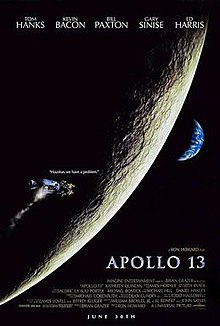
Apollo 13 (1995) - They invented "a way to put a square peg in a round hole, rapidly." "We need to
make this (square thing) fit into the hole for this (round thing) using nothing but that." 'Nuff said. If you don't know what that means, throw a party and watch one of the best movies of the 1990's. And then sell your house because it would be easier than cleaning it.
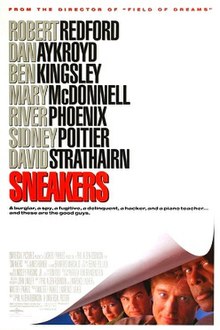
Sneakers (1992) - Good writing/directing and an AMAZING all-star cast. What could make this even better? How about some amazing hacking using old-school social attacks? The theory of a key-to-end-all-keys is a bit out there but not 100% impossible. The best thing about this movie is that they use very little technology to break into a building overflowing with it. And it's the best River Phoenix movie out there.
The Social Network (2010) - Not a bad movie, if you unplug the plot from reality for 90 minutes. The "Winklevi" portrayal by a single actor is amazing. What is more amazing, though, is Zuck's first "Facebook" hack where he collects information about coeds from various "Facebooks" of Boston-area colleges/universities. It is a VERY well-shot scene with explanations that actually make sense. Would love to hear a modern web developer poke holes in it, since I haven't coded in any of the platforms used in the hack (Python, AJAX, etc). Key point: what he did is completely possible and it was portrayed in a cool way.
Cloak & Dagger (1984) - A mid-80's kids movie? What could possibly be interesting in here from a geek perspective? How about hiding top-secret data in an Atari cartridge? And the only way to access it to play the game in a certain way. BRILLIANT! Yes, it's an 80's kid's movie so don't expect a lot of plot or character development.
The Girl with the DragonTattoo (2009) - Lisbeth (the main character) is a private investigator, of sorts. What does she investigate? People, using her computer. Or rather using their computer to investigate them with some awesome hacking using real tools and methods.
And now, brace yourselves for...
The Worst
Clear and PresentDanger (1994) - I actually like this movie. I'm a big Tom Clancy fan and I was really into this movie right up until I heard the nameless CIA tech say, "OK, sweetheart, let's get to work!" Jack Ryan has just asked him to do something of questionable legality and high difficulty, so he starts talking to his computer. Now, I have no
problem with nerds who talk to their computers. Shoot, I do it all the time
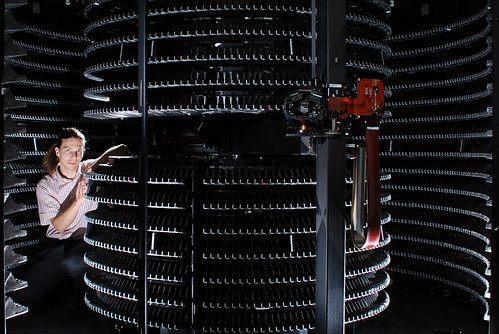
using somewhat colorful metaphors. My problem with this movie, which almost makes this movie unwatchable for me to this day, is that he wasn't actually talking to a computer. He was talking to a StorageTek 9310 PowderHorn tape silo (you can clearly see the StorageTek logo on the robot arm).
I'm sorry, a tape library robot is not a computer, no
matter how you talk to it. It does look a lot more impressive than a mainframe (most likely what a CIA tech would have used to pull off this hack in 1994) with its arm swinging around but it cannot calculate squat. What it can do is store upwards of 150,000 tapes and several hundred terrabytes of data. Yes, those were impressive numbers considering the average desktop computer had less than 1 gigabyte of disk space.
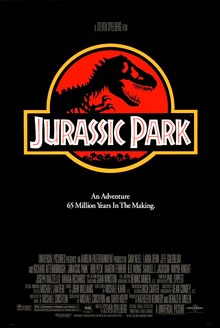
Jurassic Park (1993) - If we were talking about how computers were used to create the film this one would be near the top of the list. But we're talking about how they are portrayed in the film. Nedry's computer setup is interesting (even Samuel L. Jackson can't hack into it!) but it is easily figured out by a little girl with big eyes. The worst part? An 11-12 year old girl knows how to use a $50K SGI workstation? Not on your life.
And apparently not on her life either.
WarGames (1983) - Yes, this movie is in the best and worst category. I'm that fickle. Why is this one the worst list? For all the cool stuff they did with computers there is one thing they did that still bothers me 30 years later. When he first connects to the WOPR, David Lightman hooks it up to a sound processor to have it interpret the text into words, pretty revolutionary for consumer tech in his day, but it doesn't stop there. From then on through the film the WOPR
can talk to him, and in the EXACT same voice no matter which workstation he is using.
In 1983. No. Way. Oh, and the launch codes are cracked 1 digit at a time.
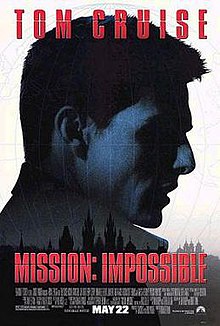
Mission Impossible (1996) - I won't go into the weird portrayal of email or AOL screen names, or whatever it is that Tom Cruise uses to communicate with Job, I suspended my disbelief on that one. What cracks me up every time is the hanging-by-a-wire ballet scene in the computer vault. A super-secret, super-expensive CIA computer, connected to nothing, that is incredibly hard
to access? What exactly does it do? The antithesis of user-friendly or even
usefullness. Why have such a secure room for a computer that holds digital data that is no doubt available elsewhere? Ugg. I'll stop now on that one because the next one is worse...
Enemy of the State (1998) - Will Smith and Gene Hackman in an action thriller? What could possibly go wrong? How about Jack Black using infinite zoom and 3D rotation on a grainy surveillance camera? (skip to 2:06 in this video)
Yes, this is one of Jack Black's earlier film roles where he plays a tech geek hired to pursue Will Smith at all costs. Including stretching the reality of 1998 graphics software and audience intelligence levels.
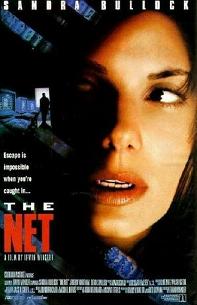
The Net (1995) - ID theft,
corporate espionage, and public infrastructure in danger over the internet?
Reality in 2013 but in 1995 it was a pipe-dream. If they had set the movie in
the near-future (a la Minority Report) it would have made more sense. Instead they tried to twist 1995 technology to make it look like it could do incredible things that simply weren't possible. If they made that movie today people would probably just shrug their shoulders and say, "Meh. The NSA does that on a Tuesday."
Swordfish (2001) - This one is the absolute worst. I thought I was watching an action movie, not a laugh-out-loud comedy. There are just far too many situations that stretch their geek cred a little too far. The low point is near the beginning when John Travolta, soul patch and all, puts a gun to Hugh Jackman's head and asks him to hack in a DoD database protected with 128-bit encryption in 60 seconds while
being, um... "distracted" and typing at what must be 300 WPM. Which invariably works. Because movies.
Honorable mentions
from TV:
CSI: NY - "I'll
create a GUI interface using Visual Basic to see if I can track an IP
address." Wow. So much ignorance crammed into one sentence.
Numb3rs (2005-2010) - One of my favorite shows of the time but they constantly made me laugh any time they showed the inside of the FBI office. They put together quite the swanky FBI office in downtown LA with projected computer screens and great looking graphics but the prop computers sitting in telco racks are 15-year-old (at the time) 1990s-era Compaq servers. I have spent countless hours working on them, including the oft-represented Proliant 6500. If you look closely enough in some scenes the server had 1.6" 9GB drives. Those were smokin' systems in 1998. Now my phone has more storage and processing power. And none of them were ever powered on which would have made dialog in the near vicinity inaudible.
NCIS - Arguably the highest rated show on TV right now but they still have their moments. Like having two people
hacking on the same keyboard at the same time, where the hacker is hacking a single computer but the target cannot be isolated. How is the hack stopped? By the two 1D10Ts typing in the keyboard? No, by the main character unplugging the !@#$% computer. Brilliant.
And some parting thoughts...
I left out quite a few possible nominees on all categories to keep this concise. My wife complains that I am a little long-winded when it comes to things I am passionate about. I do not disagree. Neither does my son, apparently.
When movie-makers or TV people use technology it doesn't take much to make it realistic. Just screen it for a geek or two, which are VERY easy to find, and your problem can be solved. Want to do some product placement with EMC to put one of their HUGE storage arrays in a key shot? Have it be in a datacenter where it belongs, not in the middle of a @#$% conference room where the 90 dB, 1400 CFM fans would make it nearly impossible to have a relaxed conversation. Use advisers who will properly vet how you portray technology, just as you would the military, planetary science, medicine, or any other scientific aspect of your film.
Then maybe my wife will stop elbowing me when I laugh at inopportune moments of impossible ridiculousness that is technology in movies.
Hold on a minute, what about ID4? How can you possibly not mention Jeff
Goldbloom's magnum opus of hacking? Maybe because it isn't really that cool and definitely not totally impossible (i.e. it doesn't fit into either category above). His character was an EXPERT in communications. Who's to say he didn't
figure out a way to connect via TCP/IP and upload a custom virus? The display graphics aside, for a moment, it could work…
I was watching Marvel's "Avengers" recently with my kids and was reminded again why I have a love/hate relationship with movie trailers. What reminded me? This...
Hulk Grabs Ironman, grabs hold of a building, and... no spoilers.
If you haven't seen the movie stop reading now and go watch it. Go ahead, I can wait. It was only one of the best reviewed and top money-making movies of 2012. That image comes at 1:54 in "Marvel's The Avengers Trailer 2 (Official)" on YouTube. Once you have seen the movie come back here and continue reading.
And now we continue...
Marvel has this weird habit of spoiling the penultimate scene from the movie in the trailer. Yes, it looks incredible. Yes, you spent 1/4 of your budget on the CGI for that scene alone. And, yes, you need to draw-in people with these fabulous shots, I get it!
How did this spoil the movie? Maybe my memory is just too good, I don't know... But, as I was watching the finale of the "Battle of New York" for the first time, I knew exactly how they would solve that little issue of Tony Stark falling toward the ground after "resolving" the invasion situation. Why? Because the trailer clearly shows Hulk catching Iron Man while stopping his momentum using a skyscraper.
Let me be clear: they used one of the most memorable, eye-popping scenes from the movie in the trailer, where it was just as memorable and eye popping.
At about 2:20, we see Spidey fall from the top of a building and catch himself while the top of the building falls all around him. Yes, it looks really cool and it is very memorable. THAT'S THE PROBLEM.
When the "disarm the weapon at the top of the skyscraper" scene came up in the movie we know exactly how Spidey is going to fall and whether or not he survives BECAUSE THEY ALREADY SHOWED US IN THE @#$%! TRAILER!
Have you ever read the book "Ender's Game"? If you haven't, don't watch the trailer for the movie. They give away one of the pivotal plot points in the movie right in the trailer.
OK, enough of the single-scene antics. This post is supposed to be about what a trailer is actually supposed to be. Should be simple, right? There's even a guide on eHow.com.
Where did the name movie trailer come from? According to Wikipedia, which is never wrong, they were originally called "trailers" because they "trailed" the end of the movie. The promotional shorts advertised an upcoming feature film and were designed to get people excited to come and see. Since people rarely stay after a big feature film (who wouldn't want to stay seated a few minutes longer after watching epics like "The Greatest Story Ever Told" or "Dr. Zhivago"?) so movie promoters moved them to run before the big feature. In today's theaters you can expect 12-20 minutes of trailers, depending on the theater company and the time of year. I think the longest I have seen is 25 minutes of trailers. It gets really bad in the early spring as the studios gear up for summer movies.
In the 70's the movie trailer was a simple structure: show the stars of the show, play a song from the movie, and maybe actually show some footage from the movie (some early trailers were a montage of scenes from other movies starring the actors). They were short and simple.
The 80's introduced us to the voice-over trailer and Dan LaFontaine, the most prolific and well-used voice in movie history. If you have seen any movie trailer in the last 30 years you have heard his voice. Don't recognize him? Try this on for size: In your mind, think of a movie trailer and say the words, "In a world where..." Was the voice in your mind a deep, gravely man's voice? That's Dan LaFontaine who voiced an impossible number of trailers. Unfortunately he died in 2008 but his body of work is tremendous.
Now we move on to today's movies. (I'm skipping the '90s and '00s because I'm lazy)
Fast-cut scenes of action, silence/black with maybe some words, voice-over montage of key points in the movie, the villain reveal, and maybe a plot twist or two. Comedies, romances, and horror movies all have their own version of this theme but inside each genre the structure is remarkably similar.
So what makes a bad movie trailer? Here are my thoughts-
Revealing key plot points in the movie. I've beaten this one to death but there are many others who have alsoillustratedthispoint.
Revealing the ending - There are several trailers released right now that out-and-out give away the movie's ending. For a remake of a famous movie, like Stephen King's Carrie, why not leave out the ending scenes for those young kids who don't know? Wouldn't it make a better movie if they found out the ending by watching the @#$!! movie? The funny thing is that the trailer for the original "Carrie" from the '70s gave away the ENTIRE plot right in the trailer. Pulled no punches. So I doubt the modern "Carrie" promoters thought twice about doing the exact same painful thing.
Revealing the villain and their intentions - Sometimes this is just as bad as #1. Sometimes discovering the villain is the entire point of the movie. (*cough* Unbreakable *cough*)
Marketing the movie to be something it isn't. "Drive" was shown to be a "Fast and the Furious" wannabee, not a brooding drama with a little bit of driving thrown in. "Million Dollar Baby" wasn't really about boxing. "The American" wasn't actually a James Bond type of movie starring George Clooney even though it was a really good non-action movie.
Some movie trailers are better than the actual movie itself. Typically this happens because they take all the good stuff about the movie and cram it into a 3 minute trailer. This is a frequent occurrence for me. I can't count the number of times I saw a trailer for a movie, got excited to see it, and the movie was, in my ever-so-humble opinion, a dud. Like "Wreck-It-Ralph", "Wild Wild West" (that horrendous Will Smith movie), and Star Wars Ep. 1. Oh, and "Snakes on a Plane," the quintessential trailer-better-than-the-movie trailer.
Rule #1: Don't commit any of the infractions listed above. (Sorry, had to say it)
Rule #2: Show me just enough of the movie to make me want to go see it.
Rule #3: Give me the main idea of the movie but you don't have to tell me the EXACT plot.
Rule #4: LEAVE ME WANTING MORE. (most important)
Rule #5: Don't let Michael Bay make the trailer. He totally screwed up the trailer for The Island by giving us the entire plot in the first 30 seconds of the trailer. The movie-watching experience would have soooo much better with hearing Ewan McGregor give away the main plot point 1:17 into a 2:20 trailer.
With all this in mind, here are my "Best movie trailers of all time" as ranked by me.
Honorable mention: Spider Man. Not a bit of this trailer ended up in the movie. It is a bit hokey and has nothing to do with the actual movie but it did get people excited to see the movie. Unfortunately they went on to make several other trailers that violated just about all my rules for trailers.
#10 - Men In Black: The trailer does contain major plot points but doesn't give away to much of what's going to happen. The key thing they do is that you can't really tell just how much of a farce this movie turned out to be. It was only a few years post-ID4 (Will Smith's other alien movie) so we didn't know what to expect. I haven't seen my wife laugh that hard in a movie, except for maybe when we saw "Noises Off" for the first time.
#9 - Sin City: AMAZING trailer for a concept film that was way ahead of its time. Maybe someday I'll actually watch it.
#8 - 300: Once again, amazing visuals from a concept movie that pulled no punches with violence for the sake of violence. And you get the only quote that has actually been attributed to a Spartan in the movie (the part about fighting in the shade. Look it up).
#7 - Cloverfield: Just enough of a tease to make you want to see it. Unfortunately the movie was like an extended version of the trailer, although it was good in its own right. But the trailer was better.
#6 - The Matrix: "No one can be shown what the Matrix is." That tag line was EVERYWHERE in the summer of 1999. The trailer showed quite a bit of the movie but didn't give away the primary premise, which was so shocking at the time. I remember seeing it in the theater on opening night with some friends from work. During the big-reveal scene you could hear half the theater audibly gasp. My friend next to me said, "NO F-ing WAY!" (he actually said "F-ing", not the other word). This trailer lured you in, just as a trailer should. It even proved that you can show off big portions of the movie and not ruin the movie experience.
#5 - Transformers: This teaser trailer makes you wonder "what the heck did I just see?" The trailer really got the buzz going about one of the biggest movies of 2007. I won't comment on the quality of the movie but the trailer was amazing.
#4 - District 9: It starts out making you think it's a racial movie then shifts to something about aliens? No plot points, we don't even know who the major characters are going to be.
#3 - The Lion King: No, really. The original trailer that I remember seeing for the Lion King was the opening few minutes with the "Circle of Life" song, right up until the monkey-priest-guy holds up Simba for the crowd. That was epic. No plot points, no zany special effects, just awesomeness. Unfortunately I can't find that trailer online so you get this one, which is not nearly as good-
#2 - Star Wars VII. No, I mean "Austin Powers: The Spy Who Shagged Me." You see, that's the point: they toyed with the audience and played off the fact that Star Wars Ep. 1 was coming out the same summer. This was an AMAZING trailer to behold in the theaters.
#1 - Dirty Rotten Scoundrels: the ultimate teaser that shows nothing from the movie except the two main characters and a hint that they aren't exactly what they seem. None of this footage is from the movie, not even the voice-over.
So there you have it, film makers. Make good trailers and we'll all be happier together. I'd hate to swear off trailers completely.
It isn't every day that I have a positive
restaurant experience with my autistic boys so I had to share our sheer joy.
Near the beginning of a long road trip we stopped for dinner at a Subway restaurant. As I was 10 seconds into the obligatory explanation
of the ordering process to my kids, my son with Asperger says, “Dad, I understand,”
and he steps up to the counter to order. In 20 seconds his order was complete
and he had a huge smile on his face. Why?
Subway
has switched to a 5-step ordering process. Stuck to the plastic shields between
you and the sandwich items are a decals detailing each step. Each step has
listed the possible options. The decals for each step are right in front of the
item options making it incredibly clear the link between word and object.
My son
easily understood the choices to be made and, since he was able to complete his
order without any parental help, he came away happy and content. All of these
are rare for him in public spaces and left me not only speechless but tearing-up.
Good thing I was ordering last.
This
happened on the second day of our long road-trip. Any bets on where he asked to
go for lunch/dinner for the remainder of the trip?
While you are pondering that latest bit of trivia, try this one on for size...
BYU remains the nation's bastion of college sobriety, according to the Princeton Review, which has named BYU the nation's top "stone-cold sober" school for the 16th year running.
The saying "just like riding a bike" has been around for ages. It refers to doing something that's easy to understand. But there's irony in that: Physicists have no clue how bicycles work, making them some of the most complicated things in the world.
There are a lot of things wrong with the recent Supreme Court decision to uphold Obama-care but, rather than speak to the political or legal aspects of the matter, I would like to take a more reasoned approach to resolving the issues in the healthcare industry. No, I don't believe it is a crisis but it does need fixing.
Do you like your health insurance provider? No? I doubt many people do, given how many people think the healthcare system needs a complete overhaul.
Should a corporate or government entity, such as a health insurance company or the health department, decide what care you get and how much you should pay for it?
I will answer this question with an analogy: should everyone be required to have auto insurance? The answer in our current American society is an emphatic "Yes!" but only if you drive a car. If you choose not to drive a car you are not required to purchase this service. Who enforces that law is another story (hint: it's NOT the federal government) but think about auto insurance in a different way: do you use your auto insurance to pay for periodic maintenance? Oil changes? Windshield wipers? How about gasoline? The idea is simply idiotic. It is almost always cheaper in the long run to pay out of pocket for most maintenance items for today's practical car. I use term "practical car" on purpose because if you have an expensive luxury or sports car the economics are much different. We have auto insurance as a hedge against the financial impact of being in an serious accident. In a two-party vehicle accident, where you are at fault, you end up paying for the following items for all people involved (drivers, passengers, and pedestrians)-
Repairs to both vehicles
Medical bills
Salary for missed time at work
Pain and suffering
To revisit the earlier question, let's try it with a different spin: should a corporate or government entity, such as a auto insurance company or your local department of motor vehicles (which we all love!), decide what auto maintenance you get, the price the mechanic will be paid, and what your portion of the bill will be? Does that not sound patently ridiculous? The auto-insurance industry is also heavily regulated but it allows for much greater competition and consumer choice.
Now it's time for a little history lesson. Health insurance came to popularity in the 1950s as a benefit from employers looking to attract top talent. During the post-WWII economic boom employers, desperate to hire the best talent from a very constricted pool of workers, looked for ways to increase the benefits package offered to employees while not increasing their taxable income, which would move them up the marginal tax bracket scale. Employers added all sorts of non-taxable benefits-
Health insurance
Dental insurance
Club memberships (health, golf, diners, etc.)
Expense accounts
Company cars
...the list goes on and on...
Non-taxable benefits are important because the employee sees more benefit per dollar spent by the employer than they would by increasing their salary by the same amount.
In countries with very high tax rates this effect is amplified. As an example, Israel's tax burden (income tax and nation tax combined) ranges from 35-58% plus a 16% VAT on top of every purchase. In that country companies routinely give employees free on-site meals, gas/commute allowances, and many other employer provided benefits. I worked for an Israeli-based company in the late 1990s and was astounded at all the perks my Israeli counterparts were using and they were equally astonished at the higher salary levels and lack of company provided benefits in the US.
After 50+ years of employer-provided healthcare insurance in the US it is now so engrained in today's society that many people would be upset if they received a job offer that didn't have comprehensive health insurance in the benefits package.
The answer to the health care debate may be as simple as changing over to a system where we only need health insurance for the same reason we have auto insurance: as a hedge against catastrophic health issues.
To follow the auto insurance analogy, do you pay your doctor directly for any of the following-
A simple check-up or annual/sports physical?
A quick cold/flu visit, typically to obtain a prescription cough medicine or antibiotic?
Have you ever looked at your medical bills paid by your insurance company? Do you even know how expensive it is to see your primary care physician? Would you go less or more if you had to pay cash every time you went? You pay your mechanic every time you get an oil change, why not pay your doctor when you get a physical? Most people do not know what their doctor charges for a "standard" office visit. If you had to write a check or pull out your credit card every time you visited your doctor, would you go less frequently?
Would you continue going to an auto mechanic if their prices were 30% more than the shop next door? What about the rates your doctor charges? This isn't even relevant in today's healthcare system because most of the healthcare prices you "pay" through your insurance company are pre-negotiated between your doctor's network and the health insurance company.
How do we get our healthcare system to the point where health insurance is "liability only," to coin a phrase from the auto-insurance industry? There are already healthcare plans that only cover severe or debilitating illnesses.
There has been a push recently toward a "single payer" healthcare system run by the federal government. In a way we are very close to that type of system in that we have a "a couple of payers" system. Those payers are the health insurance companies. The system itself would change greatly if that buying power were taken away from the heath insurers and placed in the hands of the consumers.
In order to do that we need to do something drastic, and this is the meat of my argument: eliminate employer-based healthcare coverage, the majority of all health insurance plans. What incentive would employers have to eliminate this valuable benefit? The answer is quite simple: repeal the federal income tax. To make up for it the federal government could switch to a flat tax or a consumption based model which would be less cumbersome and may even reduce the bureaucracy of the Department of the Treasury.
What would happen if the income tax were eliminated? Many employer perks would end. The pendulum would swing further toward cash-based compensation and employees would be free to spend their money on the healthcare program that was right for them. They could remain in a health-insurance plan that pays for everything or switch to a plan that covers those severe or debilitating illnesses that would otherwise lead to bankruptcy.
In the end this system would allow for a much more open marketplace where consumers and doctors are free to decide on their own treatment plans as well as competition in pricing and services.
Wow, it's been too long since I posted this...
This week's links cover everything from DNA research, XBox forensics, and gadget hacking! I usually try to limit it to 5 links but it this week I just couldn't do it! Here ya go with 7...
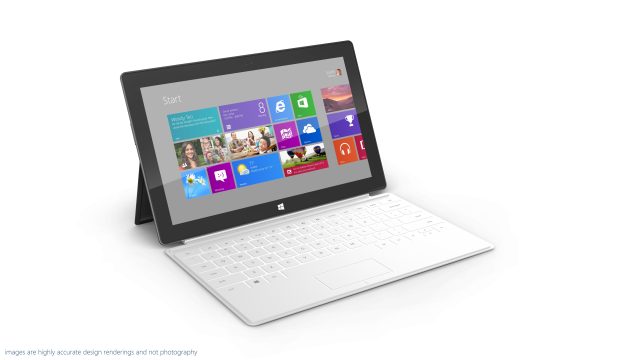
“To allow Windows 8 to compete with iOS, Microsoft needs hardware to compete with the iPad. Bad hardware would jeopardize Redmond's ability to play in the tablet space, but the PC OEMs have established for themselves a track record of producing little else. And while many of the OEMs have produced Android tablets to try to compete with the iPad, they've also consistently failed to match its quality. ”
- Peter Bright, Ars Technica
I have mixed feelings about this, having been a consumer of the Windows ecosystem for some time. Building PCs in the mid-90's was a real kick and the best way to create your dream machine for (typically) less money than buying off-the-shelf systems. Those days are long gone but not entirely forgotten (my sister built her own cheap PC a couple months ago).
This move by MS shows just how broken the old Windows OEM model is when compared to Apple. Is this move by MS a permanent one or, as the author suggests, a kick in the pants of the OEMs to get moving and to start out-innovating Apple at their own game?
“Data center operators are touting metrics like PUE to demonstrate energy efficiency leadership, but there is more to consider. Data centers exist because they can more efficiently and economically scale to house servers that host online services used by enterprises and consumers. However, we need a more holistic approach to ensure that we are minimizing the energy consumed to run these services. Performance matters, but so does the energy consumed to deliver that performance”
- Dileep Bhandarkar, Distinguished Engineer, Microsoft Global Foundation Services
Most people don't know much more about internet than to say it is, "In the cloud somewhere." Ted Stevens wasn't that far off when he esoterically described it as a "Series of Tubes." And then you see pictures like these from Datacenter Knowledge...
When you dig down into it all major internet services start in a datacenter where the equipment is hosted. Those facilities are big business, difficult to run, and incredibly expensive.
So it goes without saying that building facilities requires a lot of engineering and cost-benefit-analysis to justify building such a large facility. This article goes into a lot of details around power utilization, PUE, and other metrics that show how well MS datacenters are using the power they draw. Very interesting analysis.
“The Metro start screen may not be everyone’s cup of tea, but it does have undeniable benefits”
I have been using Win8 since the Consumer Preview last December and I have to say I love it, even on a laptop and in "desktop mode" (where I don't really use Metro apps). The list of features I like is quite long: split touch keyboard, new task manager, Skydrive integration, split screen metro apps, universal search, the advanced file copy features... too many to mention! When you run it on a device with a touch screen it really shines! Remember those touch screen tablets (i.e. laptops with swivel screens) that no one really bought? Now you can use one to run Win8 and it will amaze you. Just make sure you put an SSD in it before you start!
“Mike Apatow was minding his own business Wednesday, driving to an appointment for work in Washington Depot when a state police car appeared suddenly and signaled for the Milford resident to pull over. Apatow, 42, was entering Interstate 84 in Newtown when the cruiser appeared, and he had no idea what he'd done to merit police attention. It turns out he didn't do anything. But earlier that day, Apatow, who'd experienced a recent spike in his blood pressure, had a nuclear stress test at Cardiology Associates of Fairfield County in Trumbull. In the test, a small amount of a radioactive material is injected into the veins and used to help track blood flow to the heart.”
- Amanda Cuda, ctpost.com
So a guy is driving down the road in his vehicle and the State Police can detect if he is radioactive? First off, that's amazing but it makes you think for a minute. Yes, the technology to detect low levels of radiation, in an effort to find possible unauthorized people transporting active materials (i.e. terrorists/criminals), but do they really need it? Do we live in a world where this is necessary or is it cheap enough that they decided to do it because they could?
“What happens when all the things we based our icons on don't exist anymore? Do they just become, ahem, iconic glyphs whose origins are shrouded in mystery?”
- Scott Hanselman, hanselman.com
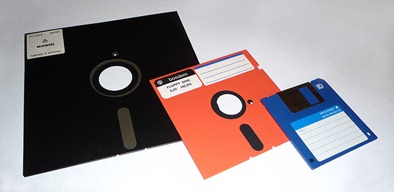
This one made me think for a minute. There are all sorts of technology that my kids will never have to use that were necessities only 10 years ago. This article takes a different spin on it: look at the icons on your computer that mean things like the save button, radio buttons, folders, etc. Will my kids even understand what those icons mean? Will they know why we call them "radio buttons"? What is a folder? What is CC:?
OK, I'm old.
“Tim Larkin tried to board a plane from his home in Las Vegas on Tuesday, but was given a UK Border Agency letter saying "his presence here was not conducive to the public good". Mr Larkin, who was due to host seminars, told the BBC the move was a "gross over-reaction". The Home Office said he was subject to an exclusion order.”
- BBC News Service
The British consider an unarmed civilian to be a threat to the public good because he is trained in self defense and the use of lethal force? Or it is because he is critical of the self-defense laws on the books? There are many limitations on speech in the UK so this should surprise no one.
Snow day! Yes, it's a snow day in Seattle, the biggest one we have had in 3-4 years.
This week's links cover everything from DNA research, XBox forensics, and gadget hacking! I usually try to limit it to 5 links but it this week I just couldn't do it! Here ya go with 7...
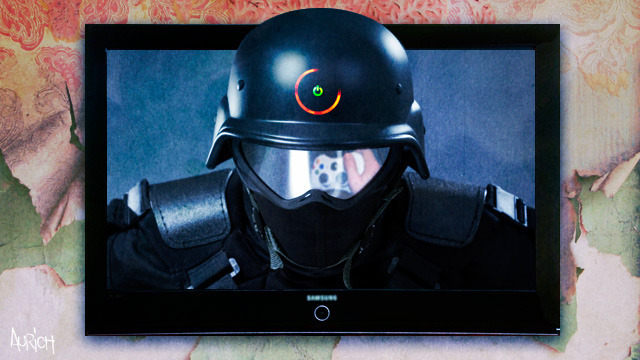
“In June 2009, a Massachusetts state trooper was gathering evidence in a case that involved a suspect having sex with an underage girl. He hoped to find one crucial piece of evidence—video of the encounter—on a digital device from the suspect's home. But the device wasn't a computer; it was the suspect's game console. The investigator was stumped as to how to sift the device for clues, and he turned to a digital forensics mailing list for help. ”
- Nate Anderson, Ars Technica
Earlier in 2011 someone in the hacker group Anonymous hacked the email account of a computer forensics expert and posted all the emails online. Part of that email cache was a lot of traffic from an email mailing list for digital crime specialists.
This article spells out many of the different scenarios in which law enforcement is using electronic devices such as game consoles, cell phones, and even mobile gaming devices to track down and prosecute criminals. Excellent read if you are interested in such geeky stuff.
“DNA may help Seattle-area sheriff's deputies find a suspect in a 20-year-old killing after a comparison with genealogy records connected a crime-scene sample to a 17th-century Massachusetts family.” - CNN Wire Staff
You may be asking yourself, "Say what? How is this Geeky?" Follow the logic: a cold-case murder from more than 20 years ago has a clue from a link to a genealogical society's DNA records. Did you follow that? Here's how it works-
People voluntarily send in DNA samples (usually a cheek swab or blood sample)
A private company sequences the DNA and sends it to the genealogy society
The genealogy society enters the DNA sequence in their database and does a little research
The society sends a report to the original DNA donor giving them an idea of which family they may be related to to give them a better idea of where to do their own family history research
How is this related to a cold case? These DNA databases are the same type of databases used by law enforcement! They can be easily cross-referenced (with a court order, of course) for forensic purposes. In this case a Sheriff's deputy in Washington state (not far from my home) got a lead on a 20-year old cold case using this very method.
This brings up all sorts of privacy and ethical issues. When you send in a DNA sample to a genealogy database you are effectively giving your DNA to law enforcement.
The proverbial "good guys have no reason to fear" argument does apply but what happens when government oversteps its bounds? The possibilities are endless.
Needless to say what might happen if that DNA DB is hacked and leaked on the internet. Be careful out there!
“So, here is the question: Can I come up with a strategy to make the wheel land at a particular spot? Clearly, there are a couple of things: Where does the wheel start? Where do you want it to end? How fast do you have to spin it and where do you let go?”
Is it possible to predict where the big wheel will stop? Is it possible to spin it just right to reliably land on $1 or a combination of two values that total $1? Rhett goes to great lengths to find out, starting with vast data collection (with the help of Youtube), kinematic equations, and more physics and math than you can shake a stick at.
But is it possible to "play the wheel"? You'll have to read the article to find out (i.e. I'm not giving it away).
“ExoPC's EXOdesk was originally a touch-enabled panel running Windows 8 and powered by a Core i7 processor. Well, after stopping by ViewSonic's booth here at CES 2012 we've learned the company has other plans for the EXOdesk. ExoPC has ditched the processor and computer components to help reduce cost, and what we're left with is merely a 1920x1080 32-inch touchscreen monitor fused to a desk. Like the original, this EXOdesk has 10 points of touch, but it simply serves as a secondary monitor for Windows (Mac support is being worked on) rather than a standalone PC. We're told EXOdesk will be shipping at the end of 2012 with a targeted price of $1299. However, ExoPC said, "price is pending a few factors: customer feedback to size, desired touch input, usage models, apps, user interface."”
- Sam Sheffer - TheVerge.com
I gave my wife an ExoPC Slate for Christmas 2010. So far she uses it a little bit and hasn't gotten used to the entire idea of a tablet. It doesn't help that Windows 7 isn't the best tablet OS out there. Win8 works much better on her tablet but the Win8 Developer Preview wasn't very useful for anyone not a software geek.
This is a fabulous idea! The EXOdesk serves as a second monitor for a PC and can be used for just about anything. The UI is very interesting and has all sorts of uses. It even got "Best Gadget of CES 2012" by PC Mag.
“The members of the Stuttgart Hackerspace have taken it upon themselves to launch their own space program. The immediate goal of the Hacker Space Program is to create an uncensorable internet in space beyond the control of terrestrial entities using a network of ground stations and communications satellites. In the longer term (think the year 2035), they'd like to put a hacker astronaut on the moon!”
Tired of meddling government censors and traditional boundaries, a hacker community has announced plans to create their own satellite network and even put a astronaut on the moon. Their goals aside (being able to share any content at any time with no governmental controls) this is the kind of project that really interests me. I don't care about breaching copyright or sharing kiddie-porn but a grass-roots effort to launch satellites and actually have them work sounds like a super-human project. I'm sure in 25-30 years this may seem trivial but with today's technology it is a HUGE task. In some ways I hope they pull it off but the governments of the world will never let it happen if it challenges their ability to censor and control content.
“The Raspberry Pi Foundation announced this week that its $35 Linux computer has entered the manufacturing stage. The system, which is an open board with a 700MHz ARM11 CPU and 256MB of RAM, could be available for sale within a matter of weeks. The foundation, which is located in the UK, was originally founded in 2009 with the aim of developing an affordable computer that children could use to learn computer programming. The organization produced two batches of sample boards last year for testing purposes prior to the recent transition to full-scale manufacturing.”
Ryan Paul - Ars Technica
Wow, a $35 PC (no monitor, of course). It runs on ARM so it has to run an ARM-compatible OS like Linux but, since Win8 will eventually support the ARM platform, eventually it will be available with other OSs as well. I may have to buy a few of these just to support the effort (this is a grass-roots, open source project).
“It's time Americans begin treating computer code the way we do the alphabet or arithmetic. Code is the stuff that makes computer programs work -- the list of commands that tells a word processor, a website, a video game, or an airplane navigation system what to do. That's all software is: lines of code, written by people.”
Douglas Rushkoff - CNN
Was "learning to code" one of your new year's resolutions? If so, there is some good news: the Code Academy has online tutorials and classes available to teach you to be a software developer within a year, with a lesson per day. Why is this important?
With cloud computing on the rise it is apparent that many IT professionals will soon need a new job (like me). My current job of IT systems design is going out the window in the next 5 years as people move to generic systems architectures like Microsoft's Windows/SQL Azure and Amazon's EC2. Re-learning C and C# is on my list and this site is helping me. Maybe I'll post some code examples if I actually stick to it.





_poster.jpg/220px-Cloak_&_Dagger_(1984_film)_poster.jpg)